Problem
Volker Stevin was awarded the contract to build a new MoD Fuel Jetty at Torpoint in Plymouth, and demolish the old one once complete.
The project had several unique floating access requirements and challenges, including:
1. Tight pile pattern – very closely placed piles under the concrete structure where most of the access was needed
2. Large Tidal range – strong cross currents and height variations up to 6m
3. Expanding scope – access needed across multiple locations for a wide range of works
4. Tight security – MoD facility
Solution
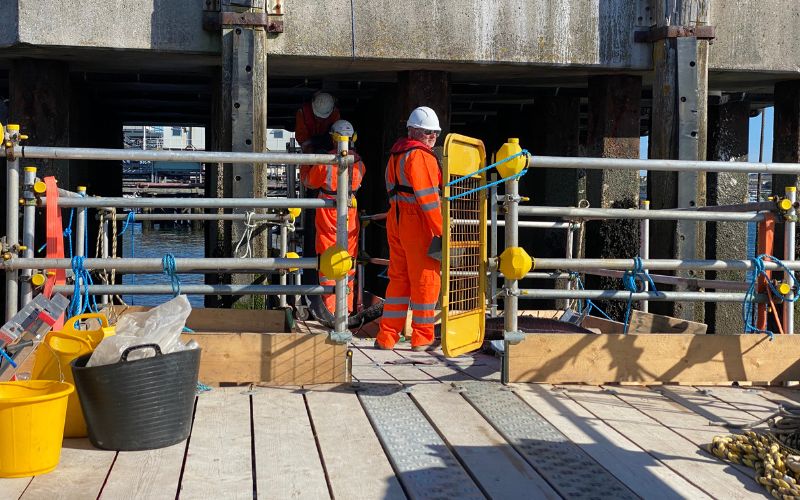
ScaffFloat designed a series of custom pontoon profiles, each designed to fit in and around a specific pile pattern under the structure. This included a ‘tuning fork’ that gave access around the pier approach piles and a ‘T Finger’ with an 8m x 1m walkway stabilised by a 4m x 4m hammerhead pontoon.
Older marine structures like piers and jetties tend to be built with a higher volume of small, closely packed piles than modern structures. This presents a tricky floating access problem as pontoons need a minimum width of around 2m to be stable. A key benefit of the ScaffFloat system is that it has a structure that can easily be modified to meet specific project requirements; in this case, the inherently unstable finger was tied into a much more stable hammer-head section, giving the customer a solution to their problem.
– The pontoon modules were pushed around the site by a self-propelled ScaffFloat, which acted as a workboat and tug, pushing each pontoon in under the complex pile pattern, holding it in place while the works took place, and being on standby to pull it out if significant vessel wash was approaching.
– Adjustable platforms were then provided to allow contractors to work for an average of 80% of the tidal range, giving access to a reach height of 4.5m.