Pier and Jetty Repair Access
Asset type
Access beneath and around piers, jetties and dolphins for repair, protection and demolition.
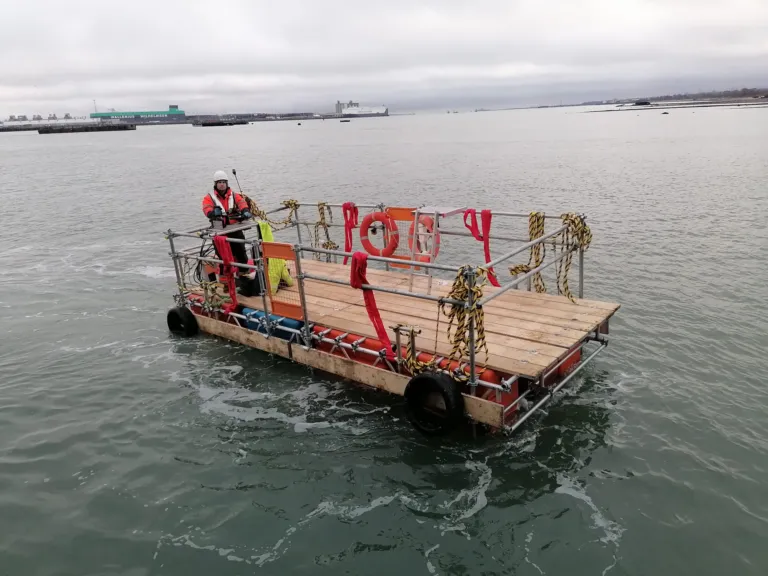
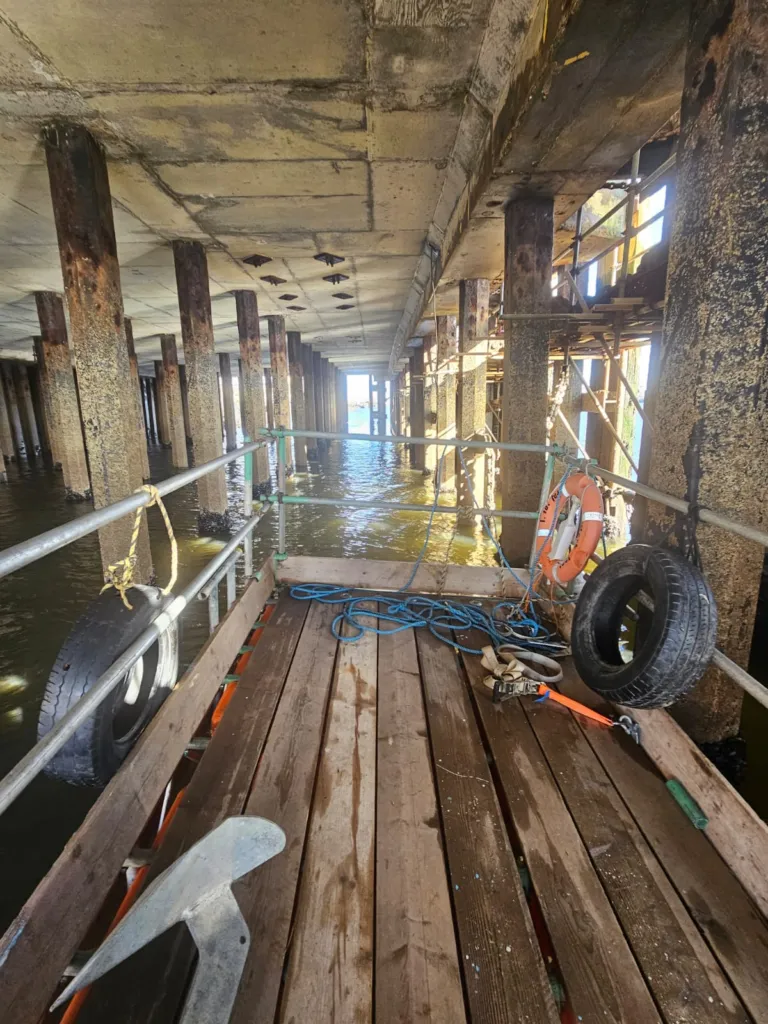
We specialise in providing safe floating access under piers, jetties, and other piled structures.
We have now provided over 5,000 hours of safe floating access for:
- Blasting (Grit and UHP)
- Painting
- Pile Wrapping
- Cathodic Protection
- Welding & Pile Repairs
- Concrete Repairs
- Survey, Coring, and Testing
- M&E: Lighting, Electrics, Services
Tool for the job
Thanks to its versatility, ScaffFloat pontoons can be configured in almost any size or shape, this allows us to design a custom pontoon for a client’s specific pile pattern.
Drawings
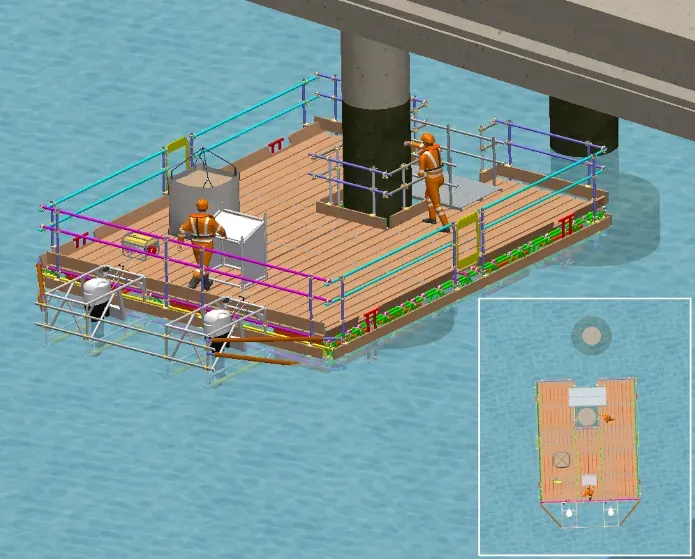
The first thing we do when we get an enquiry is request a set of drawings in plan that show the location of the piles, along with the areas that need to be accessed. Normally, we then model the structure in 3D with our design software, we can then add tide levels to help us design the right shape pontoon and plan pontoon movements. This can be especially challenging when a pier has raker piles and underwater structures and obstructions, as access and movement geometry changes at different tidal heights.
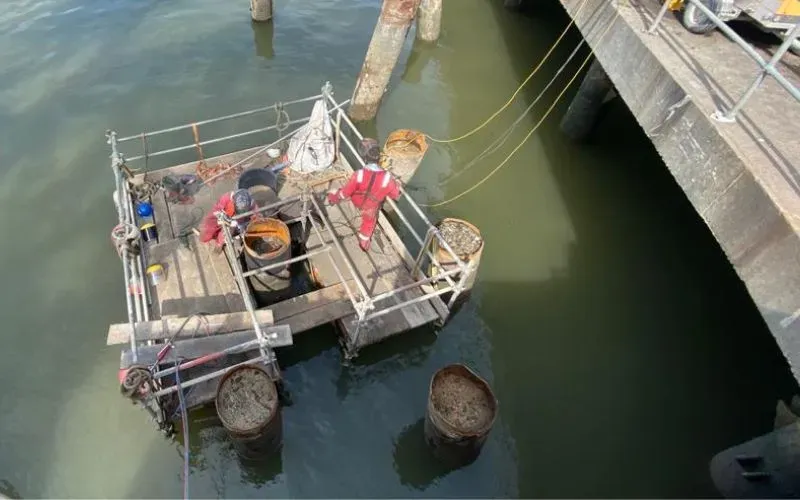
Pile recess or Horse-shoe
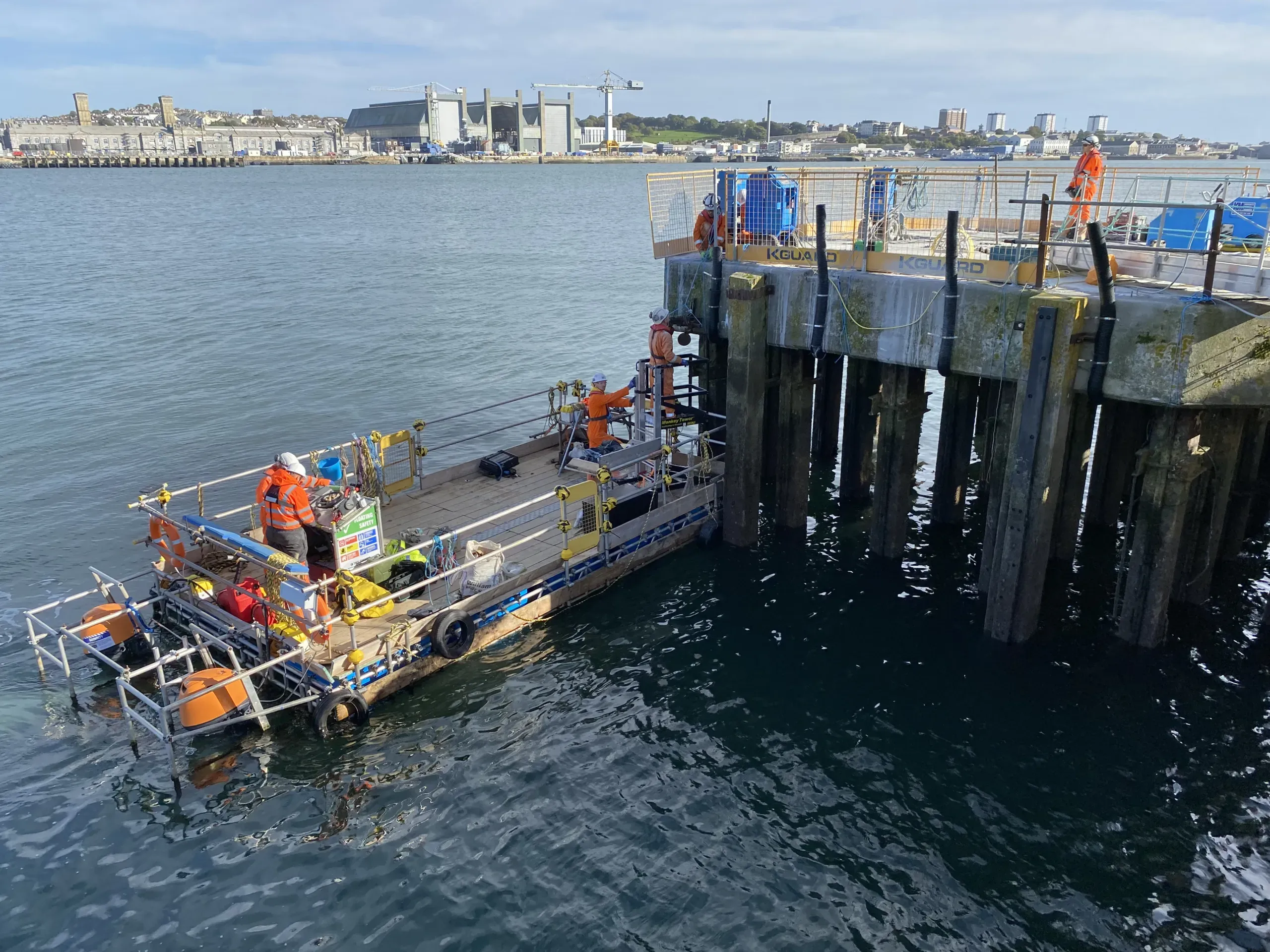
A recess in the bow allows the pontoon to dock around the pile. Wooden fendering is fitted around the inside face of the recess to protect the pile, and a drop-in gate and deck section are lowered to give 360 degree access to the pile and hold the pontoon in place against flow and wind whilst allowing it to rise and fall on the tide.

T-Finger
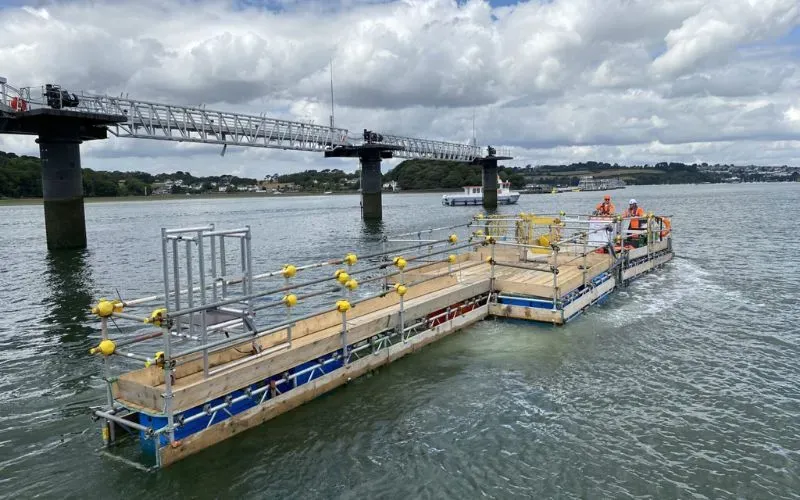
Where gaps between the piles are less than around 2m, we can’t use a long thin pontoon as it is too unstable. To solve this problem we fit a long thin finger to a larger hammerhead pontoon that makes the finger stable and sits outside the jetty acting a safe zone for workers and a storage place for tools, materials, and lighting. This tends to be used on older structures that were built on a higher density of smaller diameter piles.
Long Finger
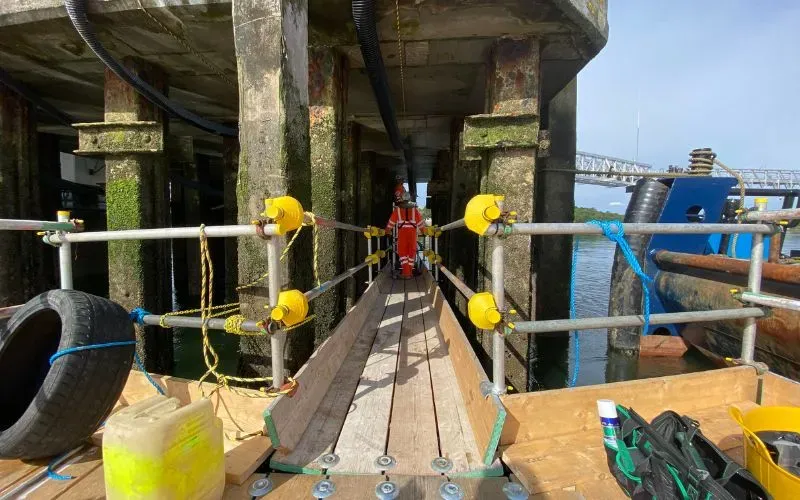
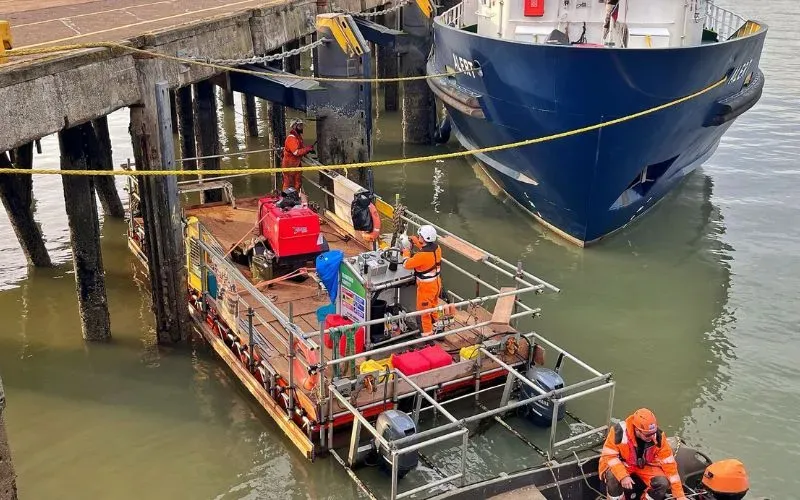
Often used on more modern structures where the gaps between piles are larger and the depth of the jetty is deeper. We use a long thin pontoon, e.g 16m x 3m, inserted from the open face to give access. This can be ‘threaded’ in parallel, or at odd angles between offset and raker piles, to get to the spot where access is needed. Normally this is attached to the front of one of our self-propelled ScaffFloat workboats which is used to push or tow the finger into position, act as a safe area for personnel, material, and equipment and the skipper and crew can keep a vigilant lookout for wash from passing vessels to give good warning to those working under the structure.

TIDE RISE & FALL
Once we have worked out how we can get in amongst the piles for access in plan, we need to look at the problem from the side. First, we consider the tidal range for springs and neaps and how this will impact the access. At high tide we may not have enough air draft to fit under the structure (including a safety gap to absorb wave chop and vessel wash). At low tide we need to plan an access system.
ACCESS PROPSAL & WORKS CALENDAR
Once we have a design and all our working heights, we produce an access plan for our client, along with a spreadsheet of estimated working times for the dates the work is planned that is produced using our tide planning software.
ACCESS PLATFORMS
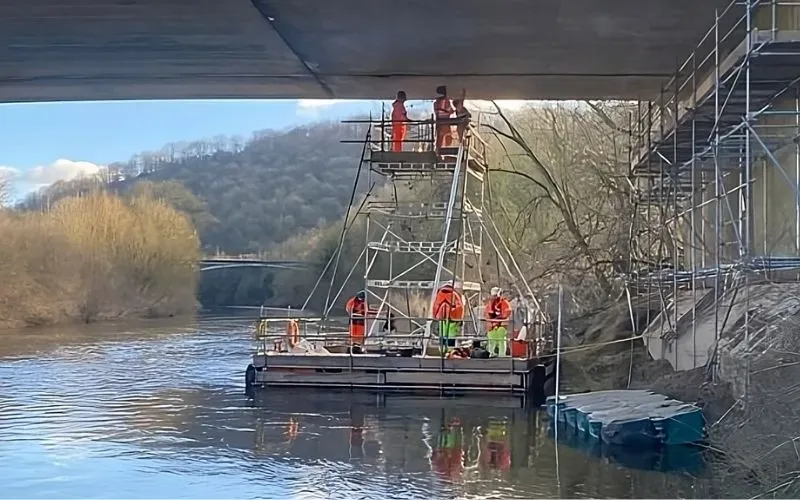
Most scaffold towers and access platforms can’t be used for floating access under structures in a tidal environment for two reasons. First is they are designed to be used on solid ground and are simply not robust and strong enough to be used in this often harsh and dynamic environment. Second, as the tide rises and falls, the platform height needs to be quickly adjusted, which rules our traditional scaffold systems and towers. Instead we use quickly adjustable podium steps like our British Made Monkey Towers, which are fastened to the deck for additional stability and to help them deal with dynamic loadings, they are also very well made and sturdy and finally the working height can be adjusted by one person in under 3 seconds, minimising lost working time. They can also be laid down on deck if needed to reduce air draft. We also use other systems, including track and trailer-mounted MEWPS.
ENVIRONMENTAL CAPTURE
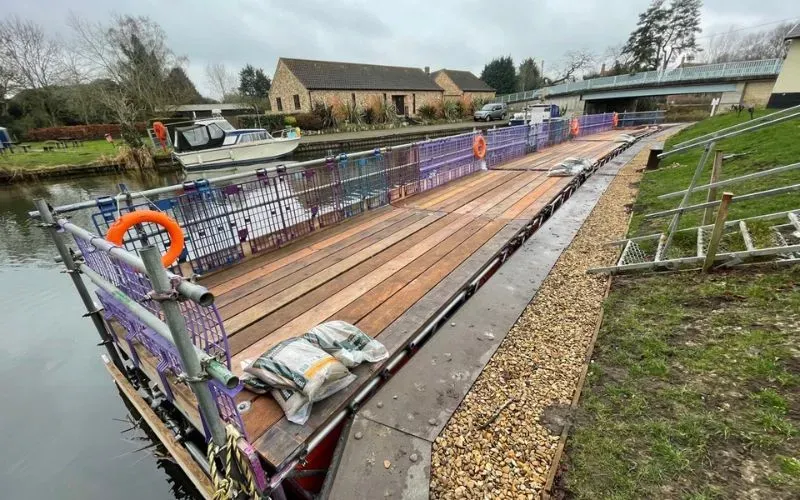
When undertaking works like blasting, cutting, scraping or painting it may be necessary to capture debris or over-spray. We can support this with modifications like over-boarding the deck, adding a bunded deck with a sump that can be pumped out, and netting normal or raised handrails.
WORKING AT HEIGHT AFLOAT
The main limiting factor when working at height of a floating platform is movement. The pontoon pivots around a point at deck level so any movement and dynamic load you experience is amplified the further above the deck you work. The two main measures we use to mitigate this movement are pushing onto the structure with engines and increasing the size and weight of the pontoon.


MANAGING RISK
Working from a floating access platform in a dynamic environment carries some unique risks that we have experience managing. We have now provided over 10,000 hours of safe floating access including over half of this under structures like piers, jetties, dolphins, and bridges. If we are providing a skipper and managing the access we will provide a full set of project-specific RAMS, onboard signage that supports the main control measures and commands, and contractor inductions and training for working afloat all logged on our i-auditor app with PDF reports of training available on request.
Piers & Jetties Case Studies
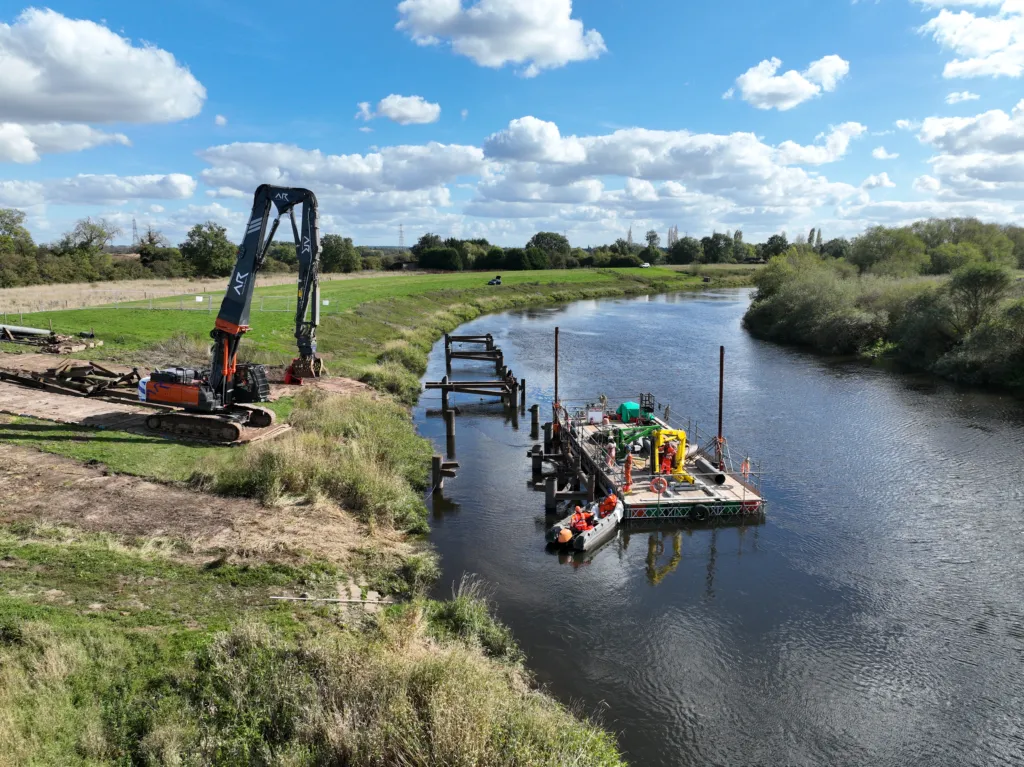
Barge Conveyor Demolition – Lincolnshire
AR Demolition required water access to demolish an old set of piles and dolphins on the upper River Trent. The structure provided moorings for visiting barges to moor to, along with support for a conveyor that ran from the quarry.
Suspended Pile Access – Africa
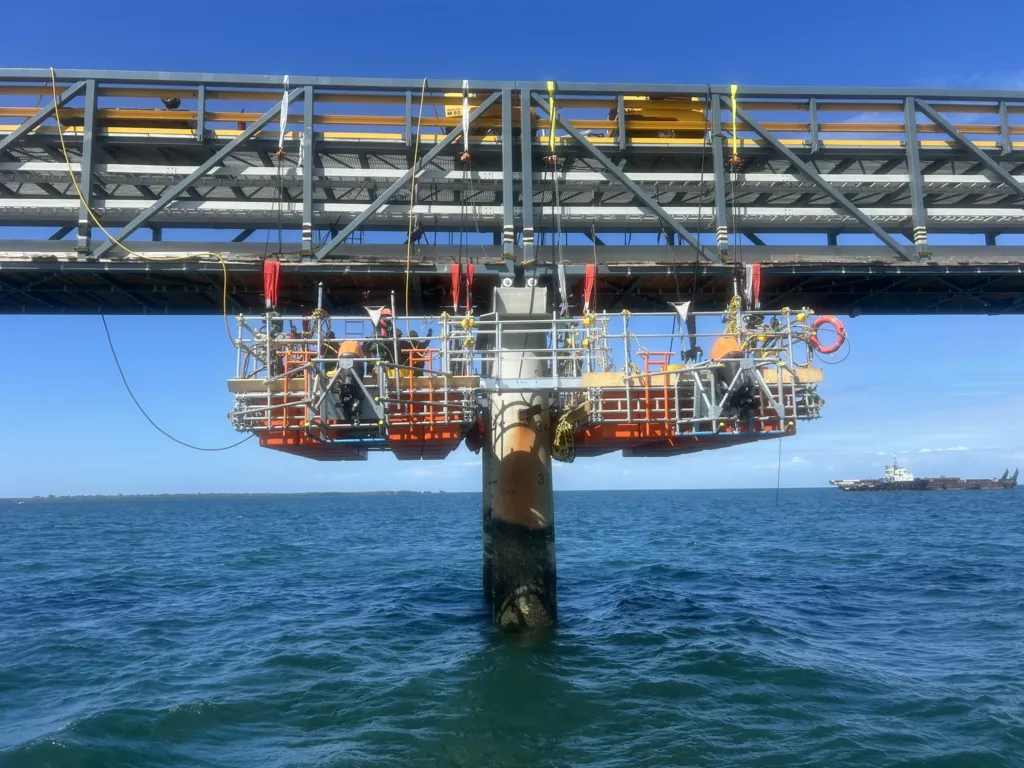
Our client in Africa needed a safe and efficient way to access and work on a long series of newly installed piles stretching from the shoreline to a jetty. The project required workers to have 360-degree access to each pile for maintenance, and the solution had to be easily repositioned to over 100 different locations.
Fixed Walkway – St Mawes, Cornwall
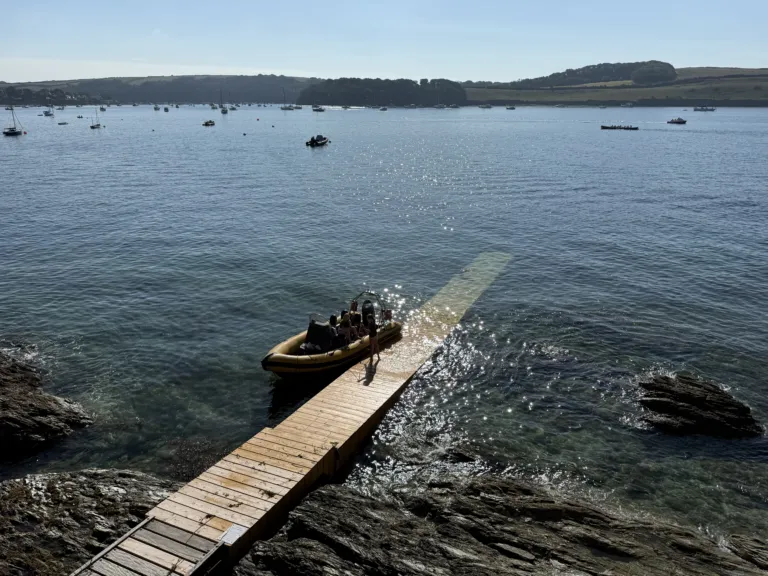
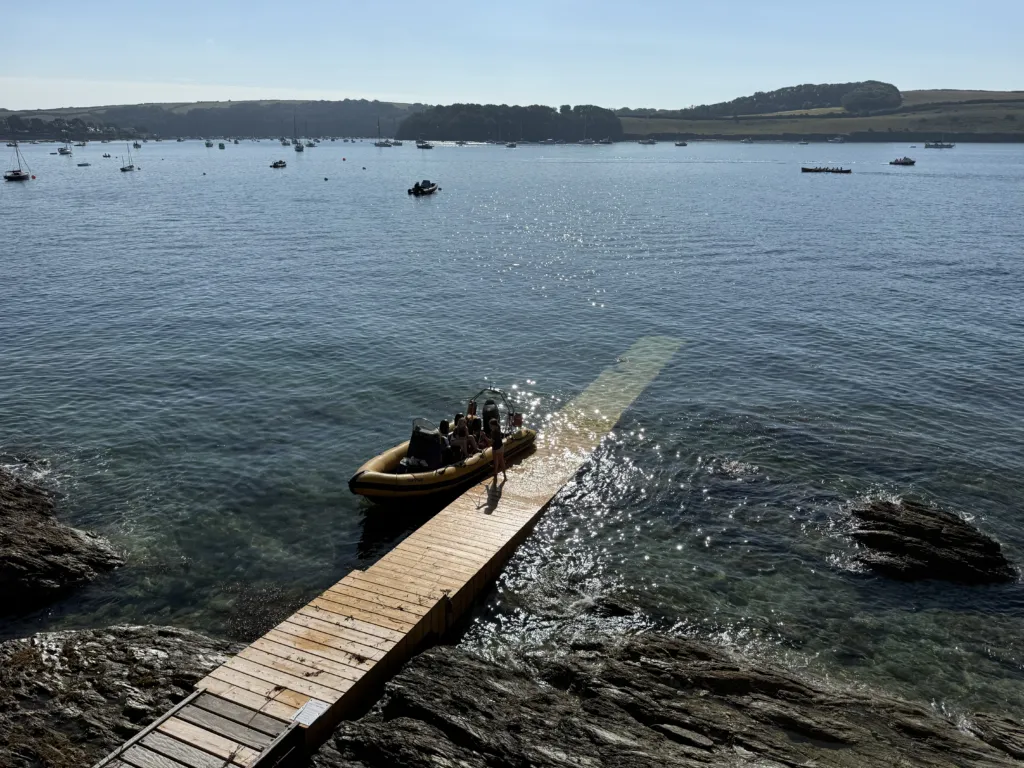
A private resident in St Mawes, Falmouth, needed a temporary, high-quality fixed walkway built for the summer season. The walkway needed to provide easy access from their waterside property to the water, even at low tide, for their holiday guests.