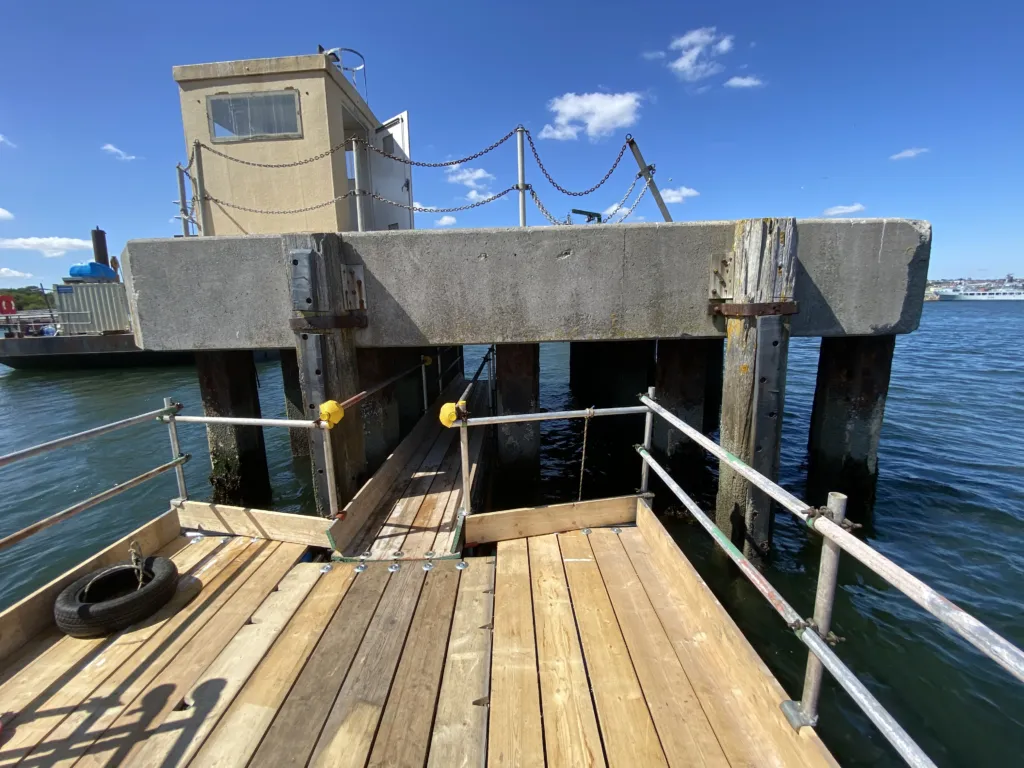
T-Finger
Perfect for tight piling patterns
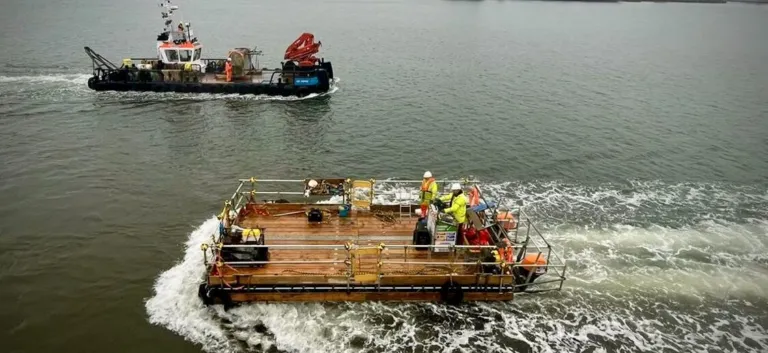
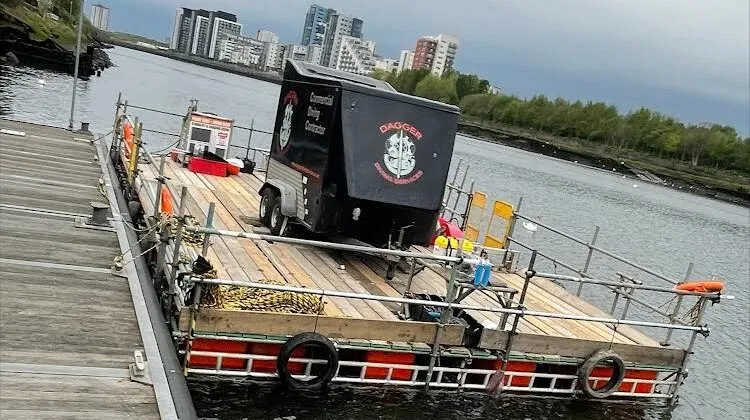
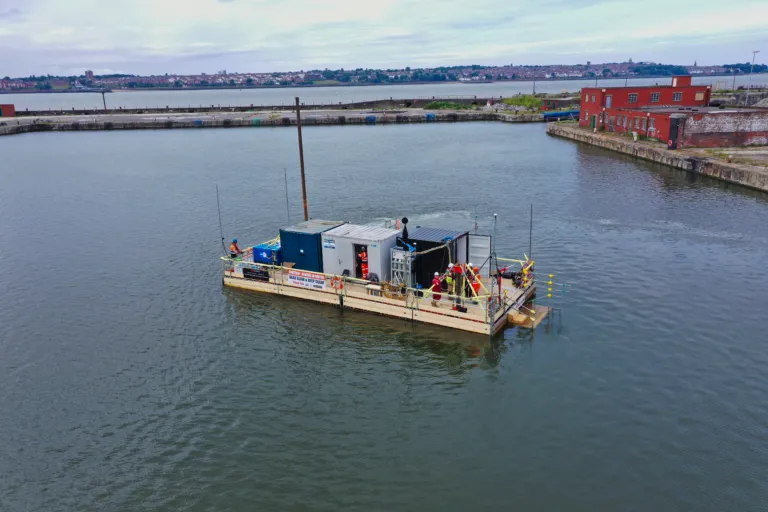
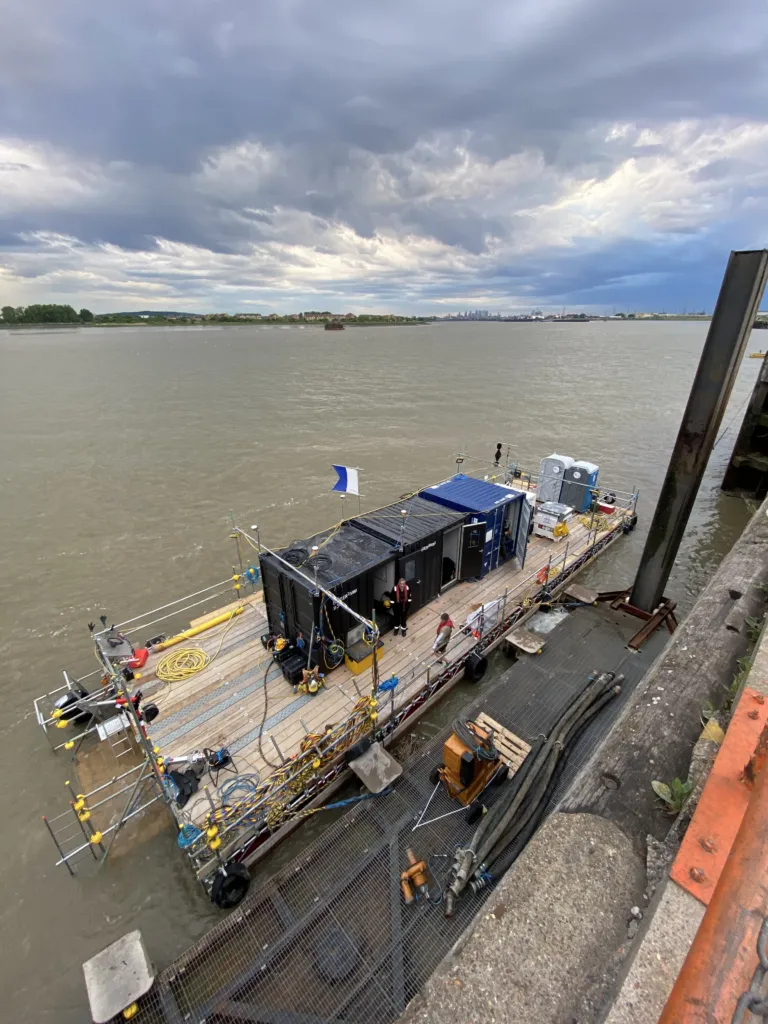
Piled Structures: Older piled marine structures often have a dense pile pattern with small gaps between the piles. Our T-Finger pontoon has a large, stable, hammerhead which sits outside the piles, with a long thin finger pontoon (minimum width 0.5m) that can be inserted between the piles. The Hammerhead gives the narrow finger stability and also provides a safe area outside the structure which can be used to store tools, equipment and plant.
Handrails: As the handrails can come into contact with the piles, and create a crushing risk for hands, we can add an additional handrail outside the inner handrail.
Access at height: We can place a Monkey Tower or Podium Steps on the finger to give reach heights of up to 4.5m above the water.
Workboat: We normally supply a ScaffFloat Workboat with the T-Finger, this performs two roles. The first is to move the T-Finger into and out of the piles by strapping it to the bow in a push tow configuration. It is very manoeuvrable and allows the skipper to control the T-Finger even in tricky wind and tidal conditions. The second role is safety, as piled structures are often next to busy commercial waterways where there is the risk of vessel wash; the workboat can quickly extract the T-Finger from under the structure if significant wash is approaching (we push on to hold position).
Size
Sizes can vary, the details below are an example for the dimensions of a finger with a 4x4m hammerhead (HH) section
| LOA | 8m (12m inc HH) |
| Beam | 0.6m (4m inc HH) |
| Draft (Lightships) | 0.3m |
| Freeboard (Lightships) | 0.5m |
| Deck Area | 20.8m2 |
| Self Weight | approx 3t |
Payload
| Floats Size | 0.5m³ |
| Float Qty | 12 |
| Total Buoyancy | 6m³ |
| Waterplane Area | 8.78m² |
| Kg per cm immersion | 88kg |
| Displacement Lightships | 1.66m³ |
| Max Displacement | 3.16m³ |
| Max Payload | 1.5t |
Specification
| Handrails | Double handrails & kickboards |
| Crane Lift Points | Yes |
| Mooring Cleats | 4x heavy duty cleats |
| Mooring Lines | 4x 4m, 4x 8m |
| Deck | Heavy duty wood |
| Sea fastenings | 4x hooks @200kg each |
| Fenders | x12 |
| Access | 2x hinged gates |
Note: Above are indicative guidelines. Specific limits will be set for each project based on operating environment, load type, activity and the RAMS for that project.
Propulsion
We recommend using one of our 8×4 Workboats with the T-Finger strapped to the front. For longer and wider T-Fingers we can also add a small outboard on the front of the finger (20hp) which is operated by the crew and acts as a bow thruster to help line up the T-Finger for insertion and extraction in strong crosswind and tide situations.
Safety pack
| Item | Details |
| Lifebuoys | Under 24m x 2. Under 24m x 4. Comply with BS EN 14144:2003 and BS 14145:2003. For cat C and D waters, at least one of the lifebuoys shall be fitted with a buoyant line and one with a light. |
| Mooring Line Set | Of suitable diameter and length (Standard pack 2 x 5m, 2 x 10m, 2 x 30m) |
| Mooring Light | Yellow flashing light to mark pontoon to navigation at night (includes spare battery, light activates in the dark) |
Note: This is a full list of safety equipment for Category D waters. Other categories of water will require less safety kit and the equipment supplied will be adapted to the circumstances of the job.
Certification & Compliance
As standard, all our pontoons come with a stability board produced by our Naval Architect, TG20 compliant edge protection and MGN469 compliant safety equipment.
We also supply a specific load assessment and limits for the planned scope of works and additional certifications when necessary or requested:
- Structural calculations
- MCA Compliance
- LOLER checks and inspections
- Eurocode and British Standards assessments and certifications
- Category III scaffolding design certification
- PLA Licensing
Our floats are available only for hire, and we are very strict about this, even though people constantly ask if they can buy the floats. We do this to maintain control over how the system is used. We make sure that every project has a proper design and stability assessment, and that we have overseen or checked the RAMS. Safety is one of the things our customers like most about ScaffFloat. Therefore, it is vital that we maintain our track record, and to do this we need to retain some control.
In terms of regulations, we operate under a range of frameworks
The Marine side: We work within the frameworks of several regulatory bodies which cover manning, safety equipment, stability standards and minimum freeboards
- MCA (the Maritime and Coastguard Agency UK)
- PLA (the Port of London Authority),
- IMO (the International Maritime Organization)
Scaffolding Regulations: Most of TG20:13 and other scaffold regulations are not relevant to what we do, but we do use elements of it for things like edge protection.
Lifting:
- Lloyd’s Register Code for Lifting Appliances in a Marine Environment
- LOLER: All our cranes are tested according to LOLER (Lifting Operations and Lifting Equipment Regulations UK)
Structural Design: If the project requires it, we use the below frameworks to assess structure. On larger projects we can also offer customers an independent Cat 3 check by our partner Richter; this gives our customers reassurance that we have taken a safe and prudent approach to our design and planned method of works.
- EuroCode EN1993-1-1-2005
- DNVGL-T-0378
- BS5975:2019 for temporary works
Gallery
Error: Contact form not found.